
Introduction
If you are starting your journey in web development, you have probably come across the terms frontend and backend many times. For beginners, these terms often feel confusing and overwhelming. This detailed guide, Frontend vs Backend Explained for Beginners, is written to remove that confusion and explain everything in simple and clear language.
Websites and web applications may look simple on the surface, but behind every click, form, and animation, there is a well-structured system working silently. To grow as a developer, it is very important to understand frontend vs backend explained for beginners, because this knowledge forms the foundation of web development.
In this blog, we will explore what frontend and backend are, how they work together, what tools and technologies they use, and which path beginners should choose first. By the end, you will have a strong understanding of frontend vs backend explained for beginners and feel confident moving forward.
What Is Frontend Development?
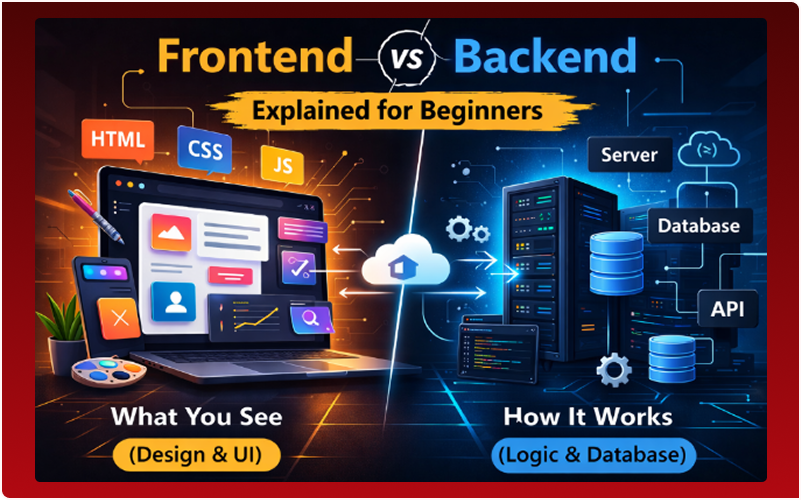
Frontend development refers to the part of a website or web application that users can see and interact with directly. Everything you view on a screen—text, images, buttons, colors, layouts, and animations—is part of the frontend.
In simple terms, frontend is the face of a website. When beginners learn frontend vs backend explained for beginners, frontend is usually easier to understand because it is visible and interactive.
Frontend development focuses on user experience. A frontend developer ensures that a website looks attractive, works smoothly, and is easy to use on different devices.
Examples of Frontend Elements
Frontend includes many visible components such as:
- Website layout and structure
- Navigation menus
- Buttons and icons
- Forms and input fields
- Images, videos, and animations
- Responsive design for mobile and desktop
All these elements help users interact with a website. Understanding these components is essential when learning frontend vs backend explained for beginners.
Frontend Technologies and Tools
Frontend developers use specific technologies to create interactive user interfaces.
Core Frontend Languages
- HTML (HyperText Markup Language): Defines the structure of web pages
- CSS (Cascading Style Sheets): Controls design, colors, fonts, and layout
- JavaScript: Adds interactivity and dynamic behavior
Popular Frontend Frameworks and Libraries
- React
- Angular
- Vue.js
These tools make frontend development faster and more efficient. For beginners, learning these technologies becomes easier once they understand frontend vs backend explained for beginners.
What Is Backend Development?
Backend development refers to the server-side part of a website or application. It handles everything that users do not see but rely on.
Backend manages data, server logic, authentication, and communication between systems. When you submit a form or log into a website, the backend processes that request.
Understanding backend is a critical part of frontend vs backend explained for beginners, even though it is not visually visible.
Backend Responsibilities
Backend development includes:
- Storing and retrieving data from databases
- Managing user accounts and authentication
- Processing business logic
- Handling server requests and responses
- Ensuring security and performance
Backend Technologies and Tools
Backend developers work with various technologies to manage servers and data.
Common Backend Languages
- JavaScript (Node.js)
- Python
- Java
- PHP
- Ruby
Databases Used in Backend
- MySQL
- PostgreSQL
- MongoDB
- SQLite
Understanding these tools helps beginners grasp frontend vs backend explained for beginners more practically.
Frontend vs Backend: Key Differences
Understanding the differences is central to frontend vs backend explained for beginners.
| Aspect | Frontend | Backend |
|---|---|---|
| Visibility | Visible to users | Hidden from users |
| Focus | Design & interaction | Logic & data |
| Runs On | Browser | Server |
| Languages | HTML, CSS, JS | Node.js, Python, PHP |
| Main Goal | User experience | Data processing |
This comparison makes frontend vs backend explained for beginners easy to understand.
How Frontend and Backend Work Together
Frontend and backend communicate with each other using APIs. When a user interacts with a website, the frontend sends a request to the backend. The backend processes the request and sends a response back to the frontend.
This interaction is the core of modern web applications and a key concept in frontend vs backend explained for beginners.
Real-Life Example: Login System
Let us understand frontend vs backend explained for beginners with a simple login example:
- User enters email and password (frontend)
- Frontend sends data to the server
- Backend verifies credentials
- Backend sends success or error response
- Frontend displays the result
This example shows how both sides work together.
Who Is a Frontend Developer?
A frontend developer specializes in building user interfaces and improving user experience.
Skills Required
- HTML, CSS, JavaScript
- Responsive design
- Basic design principles
- Performance optimization
Frontend roles are popular among beginners learning frontend vs backend explained for beginners.
Who Is a Backend Developer?
A backend developer focuses on server logic and data management.
Skills Required
- Server-side programming
- Database management
- API development
- Security concepts
Backend development attracts those who enjoy logic and problem-solving, an important insight in frontend vs backend explained for beginners.
What Is Full Stack Development?
A full stack developer works on both frontend and backend. They understand how the entire system works together.
Learning frontend vs backend explained for beginners is the first step toward becoming a full stack developer.
Which Should Beginners Learn First?
For most beginners, it is recommended to start with frontend development.
Reasons:
- Visual feedback is motivating
- Easier to understand basics
- Builds confidence quickly
After frontend, beginners can move to backend. This learning path supports frontend vs backend explained for beginners effectively.
Career Opportunities
Web development offers strong career opportunities.
- Frontend Developer
- Backend Developer
- Full Stack Developer
Understanding frontend vs backend explained for beginners helps you choose the right career direction.
Common Mistakes Beginners Make
Beginners often:
- Try to learn everything at once
- Skip basics
- Fear backend development
Avoiding these mistakes becomes easier once you understand frontend vs backend explained for beginners clearly.
Future of Frontend and Backend Development
Web development is constantly evolving. New frameworks, tools, and technologies continue to emerge.
Technologies like artificial intelligence, cloud computing, and automation are shaping the future. Knowing frontend vs backend explained for beginners prepares you for long-term growth.
External Resources
- MDN Web Docs – Learn Web Development
- W3Schools – Web Development Basics
Conclusion
Understanding frontend vs backend explained for beginners is essential for anyone entering web development. Frontend focuses on what users see, while backend focuses on how systems work behind the scenes.
Both frontend and backend are equally important. Start with the basics, practice consistently, and choose the path that matches your interest. With time and effort, mastering frontend and backend becomes achievable for every beginner.