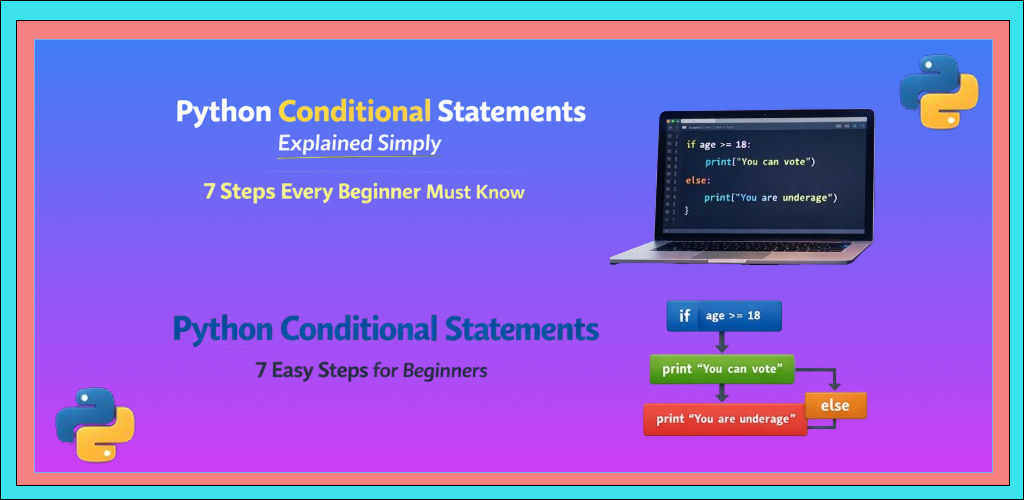

Python seekhne ke process me conditional statements ek aisa fundamental concept hai jo har beginner ko samajhna hota hai. Conditional statements ya decision-making statements allow karte hain program ko different conditions ke basis par alag behavior dene ke liye. Agar aap Python Conditional Statements Explained Simply nahi samajhte, to aapka code repetitive, inefficient aur error-prone ho sakta hai.
Is guide me hum Python Conditional Statements Explained Simply topic ko bilkul basic se advanced level tak cover karenge, real-life examples aur practical scenarios ke saath.
Python Conditional Statements Explained Simply – Introduction
Conditional statements programming me ek basic logic provide karte hain: “Agar ye condition true hai to ye karo, nahi to wo karo”.
Python me conditional statements ka main purpose hai:
- Program ko decisions lene me help karna
- Code ko dynamic aur interactive banana
- Errors aur unwanted behavior avoid karna
Jab aap Python seekh rahe ho, to conditional statements samajhna critical hai, kyunki ye loops, functions, data processing, automation aur web development me har jagah use hote hain.
What Are Conditional Statements in Python?
Conditional statements ko decision-making statements bhi kaha jata hai. Ye program ke flow ko control karte hain.
Python me commonly 3 types ke conditional statements hote hain:
ifstatementif-elsestatementelif(else if) statement
Har statement ka role alag hai, aur jab aap ye samajh jaoge, tab aapka code zyada readable aur efficient ban jayega.
1. The if Statement
if statement ka use tab hota hai jab aapko ek condition check karni ho aur agar wo true ho to koi action execute karna ho.
Syntax:
if condition:
    # code to execute
Example:
age = 18
if age >= 18:
    print("You are eligible to vote")
Output:
You are eligible to vote
Yahan, program check kar raha hai agar age >= 18 true hai to message print hoga.
2. The if-else Statement
if-else ka use tab hota hai jab aapko true ya false dono cases handle karne ho.
Syntax:
if condition:
    # code if true
else:
    # code if false
Example:
age = 16
if age >= 18:
    print("You can vote")
else:
    print("You are too young to vote")
Output:
You are too young to vote
Is statement se program dono scenarios handle kar sakta hai, jo real-life applications me bahut common hai.
3. The elif Statement
elif ka use multiple conditions check karne ke liye hota hai. Ye if aur else ke beech ka bridge hai.
Syntax:
if condition1:
    # code1
elif condition2:
    # code2
else:
    # code3
Example:
marks = 75
if marks >= 90:
    print("Grade A")
elif marks >= 75:
    print("Grade B")
else:
    print("Grade C")
Output:
Grade B
Python Conditional Statements Explained Simply ka real magic elif me dikhta hai, kyunki ye multiple scenarios ko efficiently handle karta hai.
4. Nested Conditional Statements
Conditional statements ke andar aur conditional statements bhi likhi ja sakti hain. Isse program aur flexible aur powerful ho jata hai.
Example:
age = 20
marks = 85

if age >= 18:
    if marks >= 80:
        print("Eligible for scholarship")
    else:
        print("Not eligible for scholarship")
else:
    print("Too young for scholarship")
Output:
Eligible for scholarship
Nested condition ka use complex decision-making me hota hai.
5. Conditional Operators
Python me conditional statements me comparison operators aur logical operators ka use hota hai:
Comparison Operators:
==(equal to)!=(not equal to)>(greater than)<(less than)>=(greater than or equal to)<=(less than or equal to)
Logical Operators:
andornot
Example:
age = 20
marks = 85

if age >= 18 and marks >= 80:
    print("Eligible for scholarship")
Output:
Eligible for scholarship
Operators ke use se Python Conditional Statements Explained Simply aur zyada dynamic ho jata hai.
6. Real-Life Use Cases
Conditional statements Python me almost har domain me use hote hain:
- Web development: Login system me user credentials check karna
- Data Science: Data filtering aur analysis me conditions apply karna
- Automation: File handling aur notifications send karna
- Games: Player score aur levels ke logic implement karna
Ye examples clearly dikhate hain ki Python Conditional Statements Explained Simply beginners ke liye kitna important hai.
7. Common Mistakes Beginners Make
- Colon
:lagana bhool jana - Indentation errors
elifaurelseka misuse- Logical operators confuse karna
- Nested statements ko complex banane ki koshish
Ye mistakes avoid karne se aapka learning process smooth aur error-free ho jata hai.
Best Practices for Conditional Statements
- Clear aur readable conditions likhein
- Simple indentation follow karein
- Complex conditions ko functions me divide karein
- Comments ka use karein
- Unnecessary nested statements avoid karein
Ye practices Python Conditional Statements Explained Simply ko professional aur maintainable banati hain.
Conclusion
Is guide me humne Python Conditional Statements Explained Simply topic ko step-by-step samjha:
if,if-else,elif- Nested statements
- Comparison aur logical operators
- Real-life applications
- Common mistakes aur best practices
Agar aap Python me strong base create karna chahte ho, to conditional statements ka mastery aapko advanced topics (loops, functions, OOP) easily samajhne me help karega.